Friday, October 25, 2013


Bad Religion
“Bad Religion EP”
1981
Epitaph

3.33/5 Stars
Consensus: Although it sounds like it was recorded in a toilet, and could easily be mistaken for just about any hardcore punk band from the 80s “Bad Religion EP” represents some of the most primal and raw sounds from the group in their early years. While it’s hardly the greatest album of all time, or even Bad Religion’s career, it’s certainly a commendable start and an interesting listen.

1) Bad Religion – The opener on the album sounds great and instantly grabs you in. It has every raw and biting aspect one would expect from a punk rock album in 1981. There are enough tempo changes to grab attention and a catchy chorus to boot makes for a great song. ****
2) Politics – Not giving anyone a moment’s breathe the EP transitions into another biting fast paced song. “Politics” is punk rock standard by all means, it’s raw and gritty and it sounds like its been recorded in a toilet, which adds to the element and gives it a more raw and gritty edge. ****
3) Sensory Overload – The album reaches a lower point here and this song is particularly hard to get into at first, but does eventually manage to be catchy and redemptive. The intro sounds sloppy and out of place with the rest of the song and the song never seems to find its sweet spot, save for a couple brief moments.  **1/2
4) Slaves- Heading back to the formula of the first two tracks “Slaves” offers more “standard” hardcore punk, and it sounds great. It’s aggressive, frustrated and falls apart at the end. It fits perfectly on the album while staying fresh. ***1/2
5) Drastic Actions – The intro is the concave to “Sensory Overload” and is super grabbing and catching. The song then gets quite adding a nice dynamic to the otherwise only loud CD. Unfortunately there are a couple of nasty vocal peaks that come from low quality recordings, this kills a lot of the song and makes it hard to listen to as the levels are constantly changing. This song is also the longest on the album (a whooping 2:36) and has the least interesting aspects and tempo changes to offer, making it suffer further. **

6) World War III – This wonderful 0:55 second song is straight-forward and to the point and ends on a perfect note, just as the album was about to get redundant, Bad Religion pulls out, having said their piece. The aggressive vocals and fast guitar make this the perfect ending song to a great EP. ****

Monday, October 21, 2013


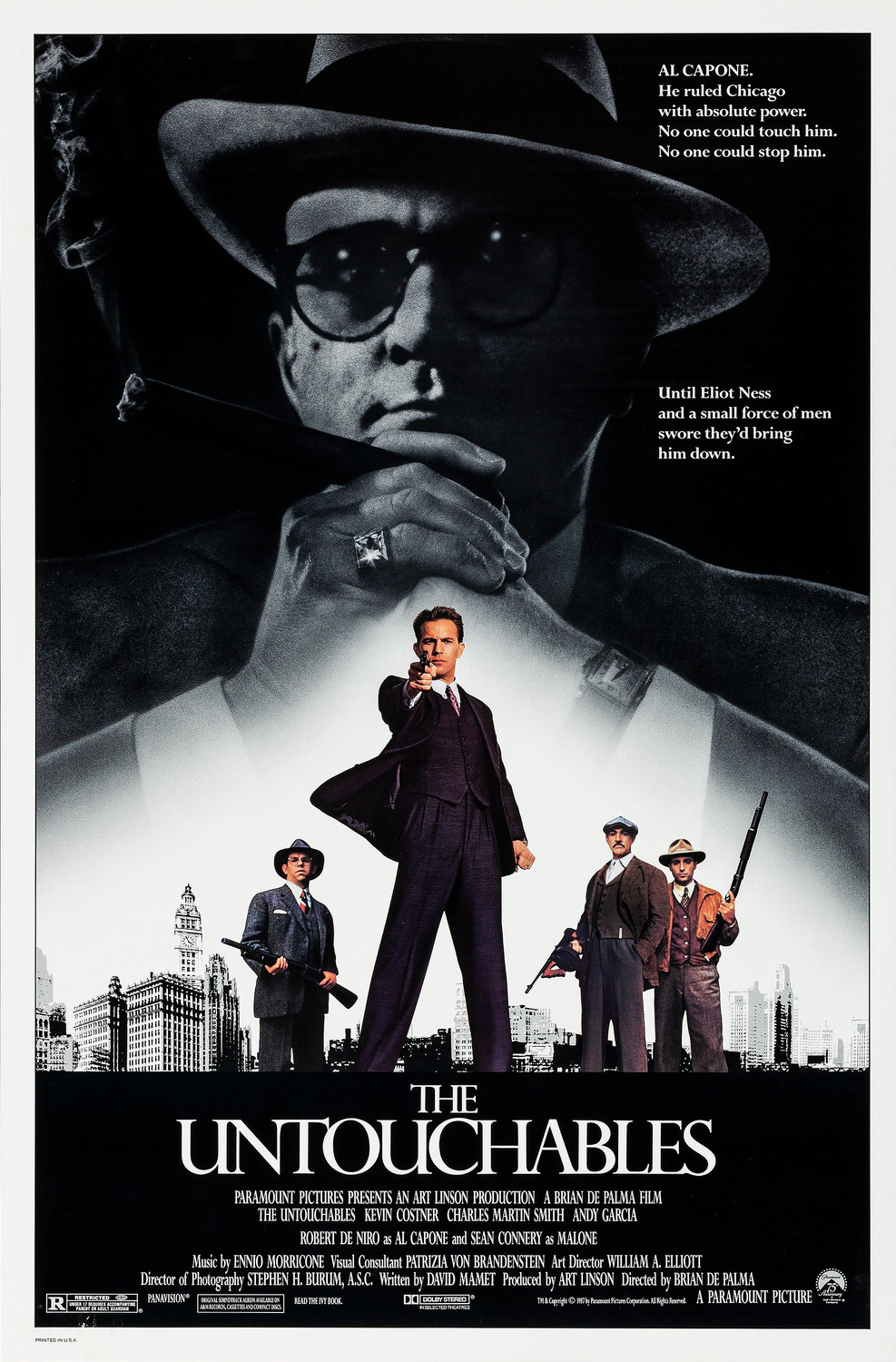
“The Untouchables”
1987
R
Produced by: Art Linson
Directed by: Brian De Palma
Written by: David Mamet
Starring: Kevin Costner, Sean Connery, Charles Martin Smith
Paramount Pictures

4.21/5 Stars
Consensus: A film that feels as classical as the era it addresses, The Untouchables is both memorable and well worth watching.

Plot: The story of the cops who brought down Al Capone (Robert DeNiro) during the prohibition era of the United States.

Directing: De Palma is most successful at creating an extremely classical tone in his more modern film; with various nods to famous films such as Battleship Potemkin (1925) De Palma has a breath of the classic era of Hollywood that feels refreshing from an 80’s flick. De Palma seemed to struggle, however, with his actor’s character arch, they seem under-directed, and notably less developed than they otherwise could have been. As a cast the actor’s never seem to quite develop a chemistry or unity together and instead feel, well… like scripted actors, and it’s unfortunate from such an otherwise polished and well toned film that this happens, but its there in more than a few parts where you realize, “oh hey… these guys are just acting, in a good movie with a good plot, but they don’t believe this.” The chemistry and tone of the actors lies largely with the director and this film struggled to find that peak, although the script, atmosphere, and all other aspects of the film were spot on. ***1/2

Acting: Again, a lack of direction hurt this otherwise great production, and we see in this film some polarity within the acting stratosphere. In particular Robert DeNiro (Al Capone) is spot on in his performance and delivers one of the most outstanding, and memorable, gangsters in film history. On the other hand we have Kevin Costner (Eliot Ness) who seems to struggle to get into his “tough-guy” cop and instead seems weak and un-emotional, maybe even a bit detached from everything that is going on. Whatever it is he’s doing, it doesn’t fit with what his character seems to be saying, or going through at all. Costner’s weak performance only makes DeNiro more desirable, and his (DeNiro's) serious lack of screen time more noticed and missed. Overall, the acting is extremely polarized and has its incredibly strong moments along with its outrageously weak and un-buyable ones. ***

Editing: In this area the film managed to really shine. The editing in the film was gorgeous and well done. Most particularly the “Odessa steps” sequence wherein Costner is in the midst of a shoot-out while trying to help a woman with a stroller up the stairs at a train station. This direct nod to Battleship Potemkin was beautifully edited together and created both intensity and beauty within the same sequence. The overall pacing of the shots and their placement was well done throughout the film, and this area may this films strongest point. *****

Art Direction: The re-creation of 1920s-40s prohibition era America contained one of the most classic tones in any film. The re-creation of suits, skirts, cars and streets was wonderfully rendered and was yet another area this film shined in. Again, the film felt classical, like it had been made during the golden age of Hollywood, the exact time-era the film was attempting to address. An enormous part of this tone is the art direction, and the art direction here was spot on. *****

Cinematography: The film opens majestically with some extreme wide shots of 1920s America and the gorgeous cinematography continues from there on out. Another wonderful shot looking directly down at Al Capone as he is getting a shave suggests that, Capone, the only person looking up at the camera, is totally set apart from everyone else in the room. He is the brains of the operation, and perhaps the only person looking opportunity dead-on. This and many other wonderful shots constitute some of the best cinematography in film history. *****

Screenplay: While the screenplay was good, and told an excellent story, it needed to be more rapid-fire to capture the tone the rest of the film so magnificently rendered. While the screen play wasn’t a complete failure, it lacked much of the intensity and wit that other gangster films such as Goodfellas (1990) or even a classic film noir such as Sunset Blvd. (1950) or The Maltese Falcon (1941) delivered so prominently. This was disappointing and inconsistent with the rest of the film’s tone and pacing, but not entirely damning as the screenplay certainly had its brilliant moments, most of the them with DeNiro, but overall the screenplay was just good. ***


CGI/Special Effects: These are especially well done and still look great even by today’s standards. Most of the special effects are explosions, and we’re ok with that since they look great and feel cool. Other blood and gore effects look grizzly and harsh, as they should, and overall the special effects were tactfully used and realistic looking. *****

Friday, October 18, 2013

“Reservoir Dogs”
1992
R
Produced by: Lawrence Bender
Directed by: Quentin Tarantino
Written by: Quentin Tarantino
Starring: Harvey Keitel, Tim Roth, Michael Madsen
Live Entertainment

4.79/5 Stars
Consensus: A Tarantino classic that is one of the most memorable, witty, and iconic gangster films ever made. 

Plot: A group of robbers are assembled to hold up a jewelry store, as complications with the robbery arise a rat is suspected among them.

Directing: Quentin Tarantino is as vicious and witty early on as he became later in his career. The dialogue is sharp, the characters aggressive and quick-tongued, and the whole film flows from violent mishap to violent mishap in a way only Tarantino can deliver. It feels a bit “film school-ish” at times, but manages to do so with the nostalgia and charisma one expects from a Tarantino film. While this clearly is not the sweet spot he would one day hit in Pulp Fiction (1994), the directing is still distinctly his, and is very holding. ****1/2

Acting: The actors all appear to be enjoying the hell out of what they are doing. Harvey Keitel (Mr. White) is great at being a gruff, but loyal gangster, his epiphany of betrayal at the end is so wonderfully communicated to the camera that it creates one of the most memorable scenes in film history. Chris Penn (Nice Guy Eddie Cabot) also gives a priceless performance along with all the other actors in the film who are memorable, and distinct. *****

Editing: Not enough good can be said of Tarantino’s fast and wild editing. The sheer pacing of the film, and the order in which it was assembled screams brilliance, let alone the flawless and gorgeous transactions that are numerable in every scene. What stands out the most is our opening exposition, the team of robbers assembled before the robbery at a diner, to the immediate cut towards the near end of the event, a man screaming and bleeding in the back of a get-away car. The sound editing is further brilliant as we hear intermittent “sounds of the 70’s” radio incorporated throughout the film as a back drop. That Tarantino had the imagination to assemble the film as such, and that he further does it with such taste and tact is impressive to say the least. One of the most superbly edited films ever made. *****

Art Direction: Especially considering the films low budget ($1,200,000) Tarantino manages to keep Los Angeles feeling as authentic as ever in this crime caper. The art direction is classy and feels very real, it succeeds especially well at re-creating the 70’s pleather and disco feel its radio intervals seemed to infer. The art direction was further successful by nodding to 70’s b-crime films while creating its own distinct flair at the same time. The art direction is perfect for what this film is, it feels like an over-the-top b-film from the 70’s, with a lot more class and certainly more style. *****

Cinematography: The film is again successful in this category. One of the most memorable, and pretty, shots in the entire film is when Mr. Blonde (Michael Madsen) leaves a warehouse to go and get something from his car, and is trailed by the camera, as he get to his car the camera stops, waits for him to get the item and then resumes following him again as he heads back into the ware house. Overall the cinematography is also exceptionally well done. *****

Screenplay: Classic Tarantino, who can be considered one of the greatest screen writers of all time, is again ever on his a-game in this film as he is in his later films. The witty banter and creative, albeit, vulgar dialogue, is as much, or if anything is more, an important of the film than any action sequences or turn of events. The fact that the majority of the film takes place in one, maybe two rooms, with a couple additional locations, and that Tarantino manages to entertain us with characters who are mostly just talking about things that have recently happened to them, makes a strong argument that this is one of the better screenplays ever written. It’s short, sweet, brutal, and to the point. *****


CGI/Special Effects: The most “special effects” that went into this film is an excessive amount of blood. It is gorgeous flowing blood, but nothing that stands out so much as to say that the film relied heavily on this category if at all. One fake looking bullet in Quentin Tarantino’s head as Mr. Brown, argues that the film likely had the low budget it did, and that perhaps works for it as much as against it in maintaining its specific “b-esq” tone. **** 

Monday, October 14, 2013


Nausicaa Of The Valley Of The Wind
1984
PG
Produced by: Rick Dempsey, Isao Takahata
Directed by: Hayao Miyazaki
Written by: Hayao Miyazaki
Starring: Alison Lohman, Mark Silverman, Tress MacNeille (English translation)
Hakuhodo

4.92/5 Stars
Consensus: Hayao Miyazaki is a cinematic genius and has on his résumé some of the most impressive films ever made. His early work is no exception to this brilliance, and Nausicaa is a fine gem in this anime sovereign’s crown.

Plot: After a devastating war that ravaged the planet a survivor named Nausicaa (Alison Lohman) seeks to understand the poisonous jungle, and the horrific insects that dwell there, that have sprung up as natural rebuttal for humanities crimes.

Directing: Not enough can be said about the sheer genius of Hayao Miyazaki. His eye for detail and vivid story telling is astounding, and shows even in his early works such as this film. He manages to create a world that immediately engulfs the viewer and doesn’t let them leave until he has said what he needs to. The pacing of the film is spot on, as is the vivid attention paid to detail and plot. Only a genius like Miyazaki could take us to such outlandish places and make them come alive in such depth. *****

Acting: When a Miyazaki film is translated into English it is always given the finest cast of English voice actors, and rightfully so as the talent needs to match the exceptional quality exhibited in story telling and animation. This film is no exception to that rule and the exceptionally talented voice cast manages to be intriguing and delightful. Patrick Stewart (Lord Yupa) is especially keen at lending us his magnificent talent and endearing voice. Overall the cast was delightful and spot on in pitch and voice acting. *****

Editing: Once again, Miyazaki is a genius and his choice of exposition and the order therein, match perfectly with the story being told; Nausicaa flows brilliantly between several subplots, all of which are incredibly constructed, and then manages to incorporate other key flashbacks. The editing in the film ads depth, insight, and important texture to the already astounding genius it is. The film’s strength lies in its excellent structure, all of which is rooted in its editing. *****

Art Direction: While it is early Miyazaki, and doesn’t quite match up to the richness of his later films, the animation and detail is still vivid and gorgeous, it’s different but that isn’t necessarily a bad thing. One of Miyazaki’s strengths is his ability to create an exceptionally detailed image that still focuses attention on what he wants you to see. In other words; the animation is vivid and big, but still manages to tell a story rather than simply show off the animators’ ability, something a film like Star Wars Episode 1: The Phantom Menace (1999) struggled with. While it looks different, and perhaps less developed than later Miyazaki, this is still a gorgeously animated film and deserves as much praise as his later work. *****

Cinematography: Animated films differ greatly from normal expectations within this category. The rule of thirds and perspective shown were all done gorgeously (see above), and while a camera did capture these images, it isn’t quite the same, so there isn’t a whole bunch to contribute to this category. n/a

Screenplay: The screenplay is a fluent and wonderful story with rich characters and incredible sub-plots. That said, this is an English translation of a Japanese film, and in this case there are a couple moments of… iffy or awkward translation, or so it felt. While this is hardly notable and barely detracts, if at all, from the otherwise brilliance of the characters, plot, and world created here, it still exists and must be taken into consideration. Again, it’s not noticeable, and hardly something to get your knickers in a twist about, but there are more than a few awkward lines, that likely result from poor translation, rather than a poor original script. ****1/2


CGI/Special Effects: Miyazaki’s animation is a standard maker; he continually raises the bar of what should be expected from animated films, especially Japanese anime. After watching a Miyazaki film, other animated films seemingly lose there sparkle because they just simply are not as good. There is so much to say about the brilliance of his animation, and his auteur as an in general, but it is better to be seen then read, and to attempt to describe in any great length would be far too wordy for our purposes here. Behold Miyazaki, king of the animated film. *****

Friday, October 11, 2013


The Hunts
“We Were Young”
2013
MCM

2.95/5 Stars
Consensus: While it has its moments, the album is just alright and very forgettable. The Hunts will get better as they get older and this is a commendable freshman album.

Sounds like: Mumford & Sons + Paul Simon + Death Cab for Cutie

1) Make This Leap – The album starts decently enough. “Make This Leap” is a bit redundant, and takes some time to find its sweet spot. The incorporation of a mandolin makes the song stick out a little more, and the violins in the song are tactfully placed, a nice tempo change towards the end followed by almost a'cappella gang vocals save the song from total mediocrity. ***
2) Lifting the Sea – This song feels the most Paul Simon-esq on the album, and certainly has the most organic feel to it. It is again refreshing to hear so many non-traditional instruments used in this song. However the song lacks a lot of charisma lyrically, and feels very sappy at times. The further the song goes on the less real it feels, and the more annoying it gets. With more depth and soul, this song would be significantly better, but what it ultimately adds up to is a pre-teen Raffi. **1/2
3) Above the Storm – The intro to this song is far too long, and again redundant. The Hunts do however exhibit one of their major strengths, that being 7 capable vocalists within their band. There is no question that a lot of talent is displayed here, but that doesn’t save this song from sounding very corporate and soulless. If it had been generated by a music making computer and performed by the very sincere and bright eyed Hunts, it would come as no surprise. Overall it is very drawn out and uninteresting. **
4) Worn – This ballad is irrepressibly dull and forgettable. With a tempo to match a funeral and the most predictable build up of all time, it takes every ounce of control to not skip this song after 30 seconds. That said, it does sound mostly different than the previous three songs on the album, an impressive feat, but ultimately no savior of the otherwise dull and forgettable 5:36 this song ends up being. **
5) This Is Love – Easily the strongest song on the album, this song is catchy and easy to get into. The transition between singers is flawless, and the lyrics are meaningful. The music behind the lyrics is powerful, unique and tactful. Perhaps the strongest thing this band has going for them is their willingness to incorporate non-guitar-bass-drums-singer instruments into their music. This song has especially effective use of this. With only a few seconds of less appealing bridge time this otherwise wonderful song is epic and memorable and stands out the most on the album. ****1/2
6) Green Eyes – The intro to this song is the most confusing and put-offish aspect to it. It is an audio clip of some sort, apparently of a man boarding a train or something inaudible, but it seems to have little significance that is easily distinguishable. Although the lyrics to this song are cute, it lacks a lot of the power it could have. It either needs to be much quieter, and played solo, or it needs to have impressive and extreme dynamics. It lacks both, but is still a decent song nonetheless. ***
7) Next to Me – The lyrics of this song flow extremely well and the use of ukulele with minimalist background instruments is effective. This song is also extremely catchy and memorable and is the second best on the album. Again the most impressive element of this song is the flow of the lyrics and the soulful singing in the song. It still has its “Raffi” edge to it, but that isn’t per-say a bad thing. ****
8) Be Naïve – Pretty vocal harmonies and nice piano create a very appealing lullaby. This is what the album’s early “Worn” and “Above the Storm” wanted to be. The three songs sound most similar, but this is the best executed of the three (whereas the other two are dull and forgettable). However, like the majority of the album, “Be Naïve” lacks the soul and voice character it needs to be a great song. This is frustrating as its potential is so apparent, and so squandered. ***
9) Beloved – Banjo, as a rule in folk and anywhere else it may be used, is one of the prettiest instruments to listen to. Putting it on the album this late makes you only think how lamentable it is that the banjo had not been more present and forefront on the rest of the album. This song has an especially appealing spiritual aspect to it that, again should have been present on the previous 8 tracks, but was absent. The overall tone of the song is very specific and makes for a strong song with a lot of power behind it. ****

10) Morning Light – Again with the lengthy Coldplay-esq piano intros, that are just thoroughly dull, and at this point in the album, predictable and boring. The ending of the album is one of its weakest points, and is the equivalent of the long speech from a relative while you are trying to leave their house and go back home. It holds no attention and doesn’t stand out at all. As soon as it begins, it should end. *1/2

Friday, October 4, 2013


Mr. Bean’s Holiday
2007
PG
Produced by: Eric Fellner, Tim Bevan, Peter Bennett-Jones
Directed by: Steve Bendelack
Starring: Rowan Atkinson, Steve Pemberton, Lily Atkinson
Universal Pictures

3.14/5 Stars
Consensus: Fun, but forgettable, Mr. Bean’s Holiday is great for an hour, but then gets a tad redundant.

Plot: Ever addled, but well-meaning, Mr. Bean wins a dream vacation to Cannes and manages to separate a young boy from his father.  

Directing: Nothing out of the norm comes from this film. The directing is well enough, but not exceptional. With a character as classic as Mr. Bean, Bendelack does manage to do his material justice and keeps the spirit of the original series alive in the film. That said, not all of the sequences totally made sense, especially towards the end, but frankly Bean is a one-gag show, and to carry that gag on for two hours is asking a lot from anyone. Although the film did get redundant towards the end, it managed to stay fresh longer than expected.  **1/2

Acting: Rowan Atkinson (Mr. Bean) is as phenomenal as ever in his now familiar role. His pantomime, that mimics silent era legends such as Charlie Chaplin or Buster Keaton, is spot on and he displays more than a little talent for his physical humor. It’s fairly redundant to note that everyone else is a back drop to his antics, but the supporting cast seems to have a blast doing what they are doing. William Dafoe (Carson Clay) especially manages to pull off a delightful parody of a self-absorbed Hollywood director, and seems to have had a ball doing so. All of the supporting cast resonated a similar feeling. It’s hardly “Best Actor” material, but its fun and tactfully executed. ***1/2

Editing: The editing matches the pacing of the skits well, even adding to some of the original scenarios. One example is of Bean’s classic skit in a high end restaurant wherein the food served is less-than-appetizing, and he must get rid of it. This sequence particularly benefited from including close-ups of the hideous sea-food and cut away shots inside the purse Bean was stowing it. Overall the editing matched the pacing of the skits well and managed to add to familiar scenes, making them funnier, or at least more vivid. ****

Art Direction: The art direction, much like the directing of the film, had nothing stand out, everything seemed fairly normal and everyone was dressed to meet their various parts. Bean is in his classic tan suit, and all the characters he interacts with have been given an update from the late 80s/early 90s wherein Bean was spawned. One bit that stood out however was a sequence wherein Bean manages to find some old Third Reich uniform on a film set and is marching up and down, pretending to play soldier. In this case the costuming and set design etc. fit perfectly for the role. Overall the art direction was well done, but not exceptionally done, very much like the directing of the film. **1/2

Cinematography: Again, nothing particularly stands out in this category; in fact the only cinematography that was very interesting at all was in the mock film Dafoe’s character makes and screens. Everything else was very cut and dry, it was clear the producers wanted to “play it safe” with this film, and for good reason, when one’s target audience is families with small children one does not put monumental effort into elaborate shots. A couple tactful close-ups here and there however assure that there was a degree of skill put into the film. The cinematography is very cut-and-dry and has almost nothing notable about it. **1/2

Screenplay: The screenplay was the film’s greatest weak point. As funny as Mr. Bean may be for 20-30 minutes on BBC on a Sunday afternoon, 2 hours of Bean following a single plot line is asking a bit much. Especially for a character that doesn’t speak. Many of the character motives made little sense, and some of the situational comedy within the film was a bit too far-fetched, especially after 2-hours. Needless to say, the characters are stock characters and are one dimensional and physical gags can only go so far without becoming redundant. A clear plot and motive never seem to really emerge from this shoty-at-best screenplay. **


CGI/Special Effects: Of all the praise this film deserves, perhaps it should be most noted that it is very free of many special effects you now see saturated in contemporary film. Atkinson, as per usual, does all his own stunts and scenes, for which we’re grateful. There is one explosion, and it looks great and authentic, and outside of that we manage to see good ol’ fashioned pantomime performed by one of the comic geniuses of our time. *****

Wednesday, September 25, 2013


“Donnie Darko”
2001
R
Produced by: Sean McKittrick, Adam Fields, Nancy Juvonen
Directed by: Richard Kelly
Written by: Richard Kelly
Starring:  Jake Gyllenhaal, Holmes Osborne, Maggie Gyllenhaal
Pandora Cinema

5/5 Stars
Consensus: A modern classic, and a personal favorite, Donnie Darko is one of the most thought provoking and memorable films of all time.

Plot: A troubled teen is plagued by visions of a six-foot tall bunny rabbit named “Frank” who tells him the world is coming to an end.

Directing: Richard Kelly’s freshman film is wrought with genius. He has an eye for absolutely everything, and directs his actors accordingly. Considering further that he also wrote the screenplay and that the film is entirely his original idea, the brilliance of his directing is further impressive. Kelly manages to create a world and environment that is deep and thoughtful. All the actors appeared very comfortable in their roles, almost flawless, and all seemed to understand their relationship with each other well. The pacing of the film alone has this wonderful feeling that moves the plot along wonderfully. Every second of this film is gorgeous and its all Kelly’s fault. *****

Acting: Jake Gyllenhaal is so thorough in his performance he as ever branded himself as “Donnie” in whatever else he plays. The perfect blend of angst, frustration, giddiness, and helpless panic are present in what seems to be every second of the film. The actors’  chemistry is flawless too, granted it helps to have your sister playing the role of… well… your sister (Maggie Gyllenhaal as “Elizabeth Darko”) but Holmes Osborne (Eddie Darko) Mary McDonnell (Rose Darko) and a young Daveigh Chase (Samatha Darko) create a family that seems and feels as belivable as if they had known each other for years. Acting is at its finest when actors dissolve into roles, and we are left only with characters that appear as realistic and complex as our actual friends and family in real life, so is the case with this film. *****

Editing: The Director’s Cut especially has brilliant editing; the incorporation of “The Theory of Time Travel” during segments to explain and emphasize plot points was an excellent add-on to the already smart cutting. Perhaps one of the most brilliant moves in modern editing history is made in this film, in an important scene as Donnie is confronted by a teacher who’s views he disagrees with, (Beth Grant as “Kitty Farmer”) we see Donnie on the verge of telling her off, just as he raises his hand to point to her in defiance the scene ends and we are with Donnie and his parents in the principles office. Brilliant moments like this made Donnie Darko as good as it was. *****

Art Direction: Perfectly capturing the nostalgia of the 1980’s, Donnie Darko almost feels like a John Hughes film, it has such attention to detail and time period, you could almost be convinced that Hughes himself lent a hand in the art direction. What the art direction succeeds the most at is creating a feeling of nostalgia for the time period it is addressing. The houses, streets, school, and clothes, all feel and look like what the 80s had to offer. You don’t for a second think that you’re anywhere else. *****

Cinematography: From wonderful swirling shots of Donnie and Gretchen (Jena Malone) on a picnic blanket in a field, to gorgeous close-ups of disturbed Donnie stabbing at Frank (James Duval) in his bathroom the cinematography is gorgeous. Steven Poster was the director of cinematography for the film, he was apparently a later, and welcomed addition to the project and rightfully so, he has an eye for angle and makes every shot breathtaking. *****

Screenplay: Between vulgar dinner-time exchanges and rants on philosophy, Richard Kelly has written a master piece. He managed to capture the obscene dialogue of teenage boys perfectly, while still adding gorgeous and poetic prose on top of all the chaos of high school. One can judge the quality of a screenplay by how quotable and memorable it is. Donnie Darko is one of the most quotable and memorable films of all time. Any die-hard fan will instantly perk up and recognize any of the films memorable lines. *****


CGI/Special Effects: There are few CGI effects and the ones used look fine. As always, less is more in this category. While CGI can be a useful tool, it is only useful when used against a story of depth and sound meaning. In this case the CGI added greatly to the films effect as Donnie digresses deeper into his schizophrenia, or as some may see it, learns more about time travel. In any case, the CGI is extremely tasteful in its use and presentation, and looks just fine, but better in the Director’s Cut. *****

Friday, September 13, 2013


"Watchmen"
2009
R
Produced by: Lawrence Gordon, Lloyd Levin, Deborah Snyder
Directed by: Zack Snyder
Written by: David Hayter, Alex Tse
Starring: Malin Akerman, Billy Crudup, Matthew Goode
Warner Bros. 

2.22/5 Stars
Consensus: A butchery of one of the greatest novels of all time,  Watchmen feels like it was made by a bunch of prepubescent boys with too much money. Snyder seems to care only about sex and violence, and throws all other aspects of; plot, character development, and human emotion, under the bus. Alan Moore has every right to be furious about this mishap of a film. 

Plot: In an alternate universe, where masked vigilantes have played a major role in modern history, there has been a plot discovered to kill off retired, and now outlawed, vigilantes known as the "Watchmen". 

Directing: Considering the rich and deeply philosophical source material from which the film is based, director Zack Snyder comes off as childish and shallow due to his overemphasis of sex and violence within the film. Not that he had an easy job, as I stated, the original graphic novel is extremely deep and has many layers that would be difficult to translate into film, one of the reasons this particular project was put off for so long. Unfortunately, getting the ever breast obsessed Snyder to direct the film adaptation of what may be the greatest graphic novel of all time was a poor choice for Warner Bros. company. In fact the only aspect of the film Snyder seemed interested in at all was the exaggerated, weird violence, and awful uncomfortable sex scenes. There seems to have been little or no attention paid to the plot, philosophy, or ideas, which the source material incorporated so gorgeously. I couldn't tell if Snyder was just trying to shock the audience or if he really genuinely thought that audiences were going to this film to see campy and gross sex that was barely, if at all, included in the original graphic novel? Snyder does not appear to have thought, cared or been interested in any of the unique and profound psychosis of any of the characters, nor did he seem to care how his actors portrayed these otherwise deep and thoughtful arch-types, as long as they were willing to get naked or torture somebody. Between senseless variations from the novel, that were less effective, to added sex scenes that were uncomfortable, long, and awkward Snyder proves to have the mentality of a pubescent 15 year old that got handed a camera. 1/2

Acting: With seemingly little direction from their, well… director, the actors struggle to say the least. Billy Crudup (Dr. Manhattan) appears to do an OK job, Crudup manages to come across as the cool, analytical super genius his character is. With some added vocal effects in post production he is convincing and easily the most appealing of this kitschy and poorly directed cast. That said, Crudup's character, although arguably the best developed of the Watchmen in the film, is still somewhat of a one trick pony. He is cool and analytical, and has occasional outbursts of emotion. That's all. Next up we have Jackie Earl Haley playing the ever troubled and dark "Rorschach". Haley's performance is something one would expect from a high school film project, campy, one-sided, and over the top in the worst way. It's like he didn't even read the source material, and his over exuberant macho just comes off, again, like a 15 year old trying to shock people. If he were in the local high school theater his performance may be acceptable, but between his over gruff voice that feels, and sounds, forced and fake rather than the product of a genuine street hardened vigilante, and a couple clips where it almost looks like he is laughing at the outrageous and stupid direction the script is going, its not a big surprise Haley hasn't really shown up in much else. Malin Akerman (Silke Specter II) seemed desperate and over the top. She would do better in a soap opera however as her bad melodrama sounds unconvincing and forced. Again, almost like she didn't read the source material, and is perhaps reading the script for the first time from a teleprompter. Patrick Wilson (Nite Owl) just seems bored with the whole thing, almost like he didn't even want the role but decided at a half job with the prospect of getting to do a sex scene with Akerman. The acting was poor, shooty and unconvincing. *

Editing: For all the bad things to say about Snyder’s work in this film, he does have a good eye for editing, especially in fight scenes. Following up from 300(2006) the stylized and over the top slow motion style fights he includes here are well paced and flashy. For this we need to give him credit, other scenes are well assembled too, especially dream, or flashback sequences wherein we get cool angles and camera effects. The voiceovers and sound editing are especially well done (even when those voiceovers are Rorschach’s ever laughable gravel). The editing was overall impressive and well done, however they could have cut about most or all of the gratuitous (and added) sex scenes and edited in essential plot points that they decided to sacrifice or omit. ****

Art Direction: The potential in this area was dwindled, especially considering the vivid and gorgeous world from which they could have drawn from, when one adapts a comic book, it seems to me it would be easy to follow the designs already drawn for you in the book. They didn't completely fail, but many of the shots seem as contemporary 2000s as much as they are 1980's alternate universe. The film struggled to truly find the nostalgia it needed to be successful, and this is again, disappointing, considering the blatantly drawn and graphically depicted source material available to them. At times clothing or set designs seem to have been given the "sure whatever" approval from what appears to be an ever aloof Snyder, and his undirected crew. The make-up was also spotty and poorly done, Robert Wisdon, made up to look like Richard Nixon, is a joke. You can see the layers of make up caked on his face to create the laughable "illusion", something you would expect from a bad b-film not from something with such a-list potential. **

Cinematography: This aspect also went from being super cool and vivid to super bland and uninteresting. That said there isn't anything particularly wrong with it, it just seems like it was given the finest attention at times and at other times it seems they just put a camera up without paying attention to angles or anything. Such carelessness is surprising, considering the vivid and close attention paid to cinematography in the opening sequence of the film, to have it later fall flat, and, at times, not even attempt to follow framework from the graphic novel. It is disappointing, and painfully obvious when juxtaposed to the intense and vivid work of some scenes, let alone the source material. **

Screenplay: The screenplay followed dialogue of the graphic novel fairly well, but also called for and included the worst. Sex scene. Ever. Rarely does a single scene manage to ruin an entire film so thoroughly. Silk Spectre II and Nite Owl's scene inside Archimedes (Nite Owl's ship) done to Leonard Cohen's "Hallelujah" is possibly the worst, campiest, and most uncomfortable thing I've ever seen in my entire life. How you get a two frame instance in the graphic novel into a full blown two minute scene that ends with Silk Spectre hitting the flamethrower button on the ship, presumably because what is happening is so "hot" is mind numbing. Awful, disgusting, weird, and campy this single scene would have ruined the film, even if the rest of the film had been the greatest thing since Citizen Kane(1941) which it certainly wasn't. Rorschach dialogue is the highlight of the screenplay, which follows the crisp and socially detached rhetoric of the novel, but it is still butchered by Haley's awful grumble (when I first heard him speak I had to audibly snort out of amusement and disbelief). The screenplay had its moments of truth, but ultimately has glaring and hideous flaws within it. **


CGI/Special Effects: This was actually very well done. Much like the majority of contemporary American film, Watchmen was largely dependent on this aspect, and it may be the only thing it did well. Especially the character Dr. Manhattan, who was entirely CGI generated, appeared very well done, and as "realistic" as the character could be, i.e. he only looked like a video game as much as his character just does anyway. So bravo Snyder, you didn't totally screw up at least one aspect of this brilliant story. ****

Thursday, September 12, 2013

Revival

So I've taken a super long, and unexpected, break from writing this blog. There's been a lot going on in my life these past few months and it just hasn't been a priority. I don't feel bad or sorry about this, that's the way life is sometimes, but I do want to get back to regular posts.

I'm coming back to this now that college is back in session. My work load is considerably lighter than it was last semester, and I feel I'll be able to make at least semi-consistent posts. I will, of course be following the same format I originally set up for my reviews.

Going forward, I'll try not to be as wordy, and to edit my entries before I post them. I will also try to review more music and books from here on out, although movies will still likely be the bulk of what I review.

Hope you enjoy! 

Saturday, January 12, 2013


"The Perks Of Being A Wallflower"
2012
PG-13
Produced by: John Malkovich, Lianne Halfon, Russell Smith
Directed by: Stephen Chbosky
Written by: Stephen Chbosky
Starring: Logan Lerman, Dylan McDermott, Kate Walsh
Summit Entertainment

3.36/5 Stars
Consensus: While it has its great moments the film is ultimately depressing and hits way too many buttons that are way too close to home. Sappy acting and poor directing made the film suffer a great deal, but its worth at least one watch and has several redeeming qualities including a great script and other powerful moments that are engaging and emotional.

Plot: We follow a quite and shy freshman by the alias of "Charlie" (Logan Lerman) as he begins high school. Charlie is friendless and suffers from depression, he is taken under the wings of upper-class men "Patrick" (Ezra Miller) and his step sister "Sam" (Emma Watson). Charlie develops feelings for Sam and eventually must learn to cope with his troubled past with the help of both her and Patrick.

Directing: Although it has its good moments, its clear author and director Stephen Chbosky is a relative new comer and just getting his feet wet. Overall he did a good job, especially for an entry level director, but there were parts of the film that were seriously lacking, specifically the main character seemed very wooden and didn't seem to understand his relationship with the other characters terribly well. This could be in part because he is a relatively new actor, but it didn't seem like a ton of time was given to directing him either. Again there were parts that were well done, its by no means totally awful, it could have used more attention to detail however. ***1/2

Acting: Emma Watson is as splendid as ever, as is Ezra Miller, but everyone else is horrendously sappy and Hallmark-esq. Its extremely tacky and unappealing. The entire cast seems to be picked from a soap opera or recruited right from high school theater. This is notably bad when compared to Miller and Watson who are stellar together, and (Watson) clearly has already had much experience with film acting. This was probably the low point of the film, and in their defense, high school drama films are difficult to pull off without much sappiness, since the entire situation is sappy to begin with. So is the nature of high school and the drama that is incurred there.  Because of this it makes the acting entirely bearable, but still unappealing in the end. Watson isn't even at her best, Miller could have benefited from better directing, but still does a great job, and everyone else is trying so hard to be good they come off like they are trying really hard to be good, and not doing a super good job at it.... **1/2

Editing: This aspect was extremely well done and well placed, especially several upsetting, but well placed and important scenes, wherein Charlie has flashbacks to his early childhood. The semi-linear editing mixed with flashbacks and voice-over narrative were effective and one of the key things that brought life to the film. Another well done scene, wherein Charlie gets into a fight in school, but blacks out, is also well done. We see the footage the initially gets blacked out, from the fight, later on as Charlie has a mental breakdown and flashbacks to his early childhood. Possibly the best element of this film was the well done editing. ****1/2

Art Direction: It looks and feels like the early 90s in Pennsylvania. Nothing is too stand out-ish, the Rocky Horror Picture bits are especially well done costuming. But nothing is so breathtaking or gorgeous we stop and say "wow the art direction in this film is so good!" it passes though. ***1/2

Cinematography: Like the art direction, nothing especially stands out. One thing that was bothersome was how hard they tried to make the film look like a super indie film. Although it technically is, it is also based off a novel many consider a modern classic, and it ironically becomes generic when you TRY to make your film look indie and low-budget. It lacked a lot of appeal in that aspect. For the most part it followed suit of the acting, very sit-com-ish and nothing super spectacular. ***

Screenplay: Ironically the actors are given very good dialogue and prose. This was another extremely good aspect of the film, its just unfortunate that the actors weren't given a better director to help them deliver the great lines they were given. You'd expect this from a novelist like Chbosky, he did a great job interperting his novel into a film, if he hadn't directed the thing as well it might be even better. Or even if he had co-directed. The best line in the movie, and the most emotional, "in that moment, I swear we are infinite" the dialogue and prose is very tragic and poetic and extremely well written dialogue that makes sense and fits each character. So its a problem of poor directing mingled with inexperienced, but potentially good actors with a great script. *****

CGI/Special Effects: There was a cool scene where a character does acid and everything blends together and time gets trippy. Outside of that we are gratefully without CGI!!! Hurray for indie films and indie budgets!!!! *****

Monday, January 7, 2013


"Django Unchained"
2012
R
Produced by: Harvey Weinstein, Reginald Hudlin, Bob Weinstein, Michael Shamberg, Stacey Sher
Directed by: Quentin Tarantino
Written by: Quentin Tarantino
Starring: Jamie Foxx, Christoph Waltz, Leonardo DiCaprio
Weinstein Company

3.86/5 Stars
Consensus: While it has its brilliant parts, Django Unchained is a far cry from Tarantino's best. It often feels exploitative of black suppression and slavery, and lacks a lot of the intelligence of previous Tarantino films, but in the end manages to be an entertaining spaghetti western.

Plot: Recently freed slave, "Django" (Jamie Foxx), seeks to free his wife with the assistance of his liberator "Dr. King Schultz" (Christoph Waltz) who is also a bounty hunter. Together Django and Dr. Shultz participate in bounty hunting and vigilantism to earn enough money and means to free Django's wife, "Broomhilda" (Kerry Washington).

Directing: Tarantino is gore obsessed as ever and maintains his ever notable auterism. That said he felt, in many instances, that he was just throwing things from all his other movies together so we could see them all at once. In this case a lot of the previous creativity, innovation, and stylistic relentlessness found in previous Tarantino films was lost and it felt just like a rehash of all his old films. From a director as legendary as Tarantino you'd expect more than just rehashing the same and more of the same. There were, naturally, some brilliant choices within the film. One scene wherein a raid of rich white southerners against Django and Schultz is being made we note several of the men falling, stupidly, off their horses. We suddenly jump back in time and see the men before the raid discussing how difficult it is to see through their KKK-esq masks (the film is set pre-Civil War so miserable groups like the KKK hadn't been formed yet). Moments like this made the film feel more original and more what you'd expect from Tarantino. If he had focused more on moments like this, rather than disgusting scenes of torture and human deprivation  while still including the graphic gun fight violence the film would have benefited greatly. As it were, it mostly felt extremely exploitative. In the same way it would have been disgusting to see Nazis abusing and torturing Holocaust victims to death in Inglorious Basterds(2009) it is likewise disgusting to see rich white southerners torturing helpless black slaves to death via dogs or castration or forcing them to fight to the death, whatever the case its in extremely poor taste in this film. See one or two Nazi atrocities that are mildly graphic, then kill a bunch of Nazis throughout your film in a joyfully stylistic manner, that's cool, see ample atrocities against slaves with not as much vengeance you've just become exploitative of an entire races suffering and suppression over a period of hundreds of years. Its wrong to proliferate on such with such little tact or repercussions within the film. Another comparative to Inglorious Basterds is that there was a defined good guy, and a defined and clear bad guy with no morals. Its hard to empathize or pity a man who is willing to kill another man in front of his 6-year old son after being coaxed and promised money. Or abuse his fellow slaves relentlessly all for a cover to get to his wife. While this isn't the low point, his enemies are far more a-moral, we also see Django blast a women away for no reason other than that she was a bystander to the oppression around her. There wasn't enough build up or character attachment to Django, and its hard to cheer for a hero in a spaghetti western who isn't all about vigilantism, the rescue of the poor and oppressed, and getting his man. Django in the end just seemed blood thirsty and jaded. Schultz seemed to lose all his intelligence from the beginning of the film towards the end of it, until he goes from being smart, witty, and resourceful, to stupid and impulsive. Overall the film is disappointing and not up to par with Tarantino's standard. Content set aside, the directing just felt like the same old tricks under a different setting. Its good directing, but Tarantino seemed more focused on trying to disgust the audience then building characters or empathy towards them.  **1/2

Acting: Now this is up to par with any other Tarantino film. DiCaprio (Calvin Candie) is particularly fun to watch, if not a bit uncomfortable, because of how well he fit his role as despotic, racist, plantation runner. Samuel L. Jackson (Stephen) is also especially good in his role as tired, old, backstabbing butler who is a despicable traitor to his race. Jamie Foxx does good with the poor direction he is given to his character. Waltz however appears to be an exact re-write of his character in Inglorious Basterds, he does a good job, to a degree, but is uncomfortable to see him try to put the same intelligence and wit into his character in this film, which is less intelligent and gives him a far inferior role, that ultimately results in his stupid, and emotional end. The actors do a great job, considering how neglected they appeared to be by their sadistic director. ****1/2

Editing: You can always count on SUPER AWESOME EDITING from a Tarantino film, and you get it in this one. Especially the clip of the Southern raiders preparing to attack Django and Schultz, you originally see them going to raid what appears to be the bounty hunter's camp, you notice several people fall off their horses and think to yourself "thats weird, but kinda funny" and don't think much of it. You're shown enough that you start guessing, but its not until the brilliant back in time cut where you see the hilarity and importance of the men falling. Other classic Tarantino moments such as big lettering across the screen to introduce or explain location/character and fantastic cut-aways make for some of the highest quality editing in town. Very well composed. The use of old grainy VHS looking film for Django's flashbacks was also cool. The best part of this film. *****

Art Direction: It looks as spaghetti western as it gets. Its nothing to totally blow your mind away, there are some well designed sets, and they wanted it to be a mimickry of, well... a spaghetti western, only set in the south. The art direction is good, it feels like the south through the lens of a b-western film whilst maintaining all that a-list shine and splendor you come to expect from Tarantino. Nothing to change your life though. ***1/2

Cinematography: Another especially appealing aspect about this film was the great camera work. The scene wherein Django kills a man in front of his son looks beautiful. Framed by Django and Schultz's shoulders we see an extreme far shot of the man and his boy working in the field, Django pulls the trigger, we see the smoke from the gun and a few seconds later the smoke and dust of the bullet hitting the wanted criminal as he collapses and his young son runs to be by his side. This and many other shots were in extremely good taste throughout the film, although many shots and angles again seemed borrowed from other Tarantino films. While it is good to establish auteur-ism that fans can be familiar with, it is bad to just rip off the same exact thing from previous films. ****1/2

Screenplay: The screenplay seemed to lack the majority of the intelligence and wit of Pulp Fiction(1994) and Inglorious Basterds, there weren't many intelligent build ups and things were painfully obvious and sometimes disgusting. The excessive use of the "n" word was also a big turn off, and again felt extremely exploitative and in painfully bad taste (outside of Samuel L. Jackson(Stephen) who makes cursing an art). Overall the same problems existed within the screenplay that existed with directing. It ultimately lacked almost all of the witty banter you'd expect and was replaced with brutal and tasteless torture/violence. There wasn't a smart plot, it was super straight-forward, no deep plot or fantastic tie-ins. That said, compared to your average screenplay it is extremely well done (I expect an Oscar nomination for best screenplay, despite my personal complaints) it's just sub-par for Tarantino. There are enough brilliant moments within the film the exploitive nature can be overlooked to some degree. Characters such as DiCaprio's are extremely well written, and there is a painful amount of attention to detail and character development. You have a pretty good idea just who these people are, and it is a creative plot, or how to rephrase? A predictable plot that goes obvious places that is given a depth and creativity most writers/directors wouldn't but Tarantino does. There must be concessions for this. Therefore... ***

CGI/Special Effects: Considering its intentionally a spaghetti western and is supposed to parody off this, the  effects look great. Super stylized, tons and tons and tons of gore. Tons. So it looks fine there isn't tons of CGI which is always a good thing. Most of the effects are blood spraying relentlessly as people get shot and that looks just splendid. One explosion looked a little fake (during the famous raid scene I'm so frequently mentioning) so that's the only flaw I can find. ****

Sunday, January 6, 2013


"Three Cups of Tea"
Written by: Greg Mortenson and David Oliver Relin
2009
Penguin Books

4.25/5 Stars
Consensus: True or not (and it appears mostly true, just exaggerated or guessed at in some parts, sloppy and unfortunate but not totally damning), Greg Mortenson's story of the beginning of CAI (Central Asai Institute) is both compelling and interesting. Its a good read and especially important as it offers an alternative to fighting the war on terror.

Plot: We follow Greg Mortenson in his real life journey to build schools for impoverished Muslim children in Pakistan and Afghanistan.

Prose: The prose is that of a "matter-of-fact" journalistic sort and for good reason. It does well to clearly explain and create pathos for Mortenson and his foundation, the Central Asia Institute (CAI). Most effectively it followed debate format in favor of Mortenson, whilst following his mission i.e. at the beginning of the book we are told briefly who Mortenson is and why this book is about him and that he is tall, then it briefly goes over many people's feelings of his shortcomings. After giving concessions to his antagonists it then proceeds to tell his story and does a marvelous job at creating sympathy for both him and the children he helps. It was interesting and easy to read prose. It wasn't the gorgeous borderline poetry you get from the likes of McCarthy or Bradbury and frankly, its a good thing it isn't, it paints a wonderfully vivid picture of Pakistan while still being easy to read and not getting hung up on minor details. Relin, as he states at the beginning of the book, is a journalist, so one would expect the prose to be good, to the point and articulate, and it is. It feels very much like reading a newspaper, only better because the story won't get old in a week. ****

Character Development: By the end of the novel you feel like you are best friends with Greg Mortenson and you find yourself inevitably rooting for him and his cause. People like Haji Ali (Mortenson's mentor) come to life and you can almost hear their voices inside your head, you feel a connection to them. Especially considering these are real life people an incredible justice has been done to them, but its not without its flaws. People like Dr. Marina, Mortenson's ex-girlfriend in the plot are villianized unnecessarily and other heroic characters such as Mortenson's wife, Tara Bishop, aren't given enough page time. Especially considering Tara's role in Mortenson's mission she ought to have been given more attention, what about the many lonely nights she spends with her children? The missed days, the heroic and noble sacrafice this women gives to her husband every day ought to have been given more attention and less to villianizing people like Marina. ****1/2

Originality: Well, you can't get much more original than what happened to you in real life. Assuming it did happen, a subject that is now highly disputed and controversial (http://www.cbsnews.com/video/watch/?id=7363068n) as it appears Mortenson exaggerated parts of the novel. That said there is no doubt that he is doing a lot of good in the middle east, at least to me. Hopefully, the allegations made against him are simply his mistake of exaggerating the truth to try and help a group of people that he loves. If so that is an unfortunate mistake, but we all make them and Mortenson does help thousands of hopeless children. That said most of allegations made against him require rather... shady sources. It seems exaggerated and hyped up. The misuse of funds is very serious, and as far as any research can be done we don't see Mortenson moving to a condo in Manhatten Beach and driving Italian sports cars especially. My personal conclusion is that he exaggerated and fish told a story to try and make himself, and his cause sound better. While this is wrong, if he apologizes we need to lay off him and recognize that he still does and has done a great amount of good in the world. Slandering him and over-hyping fish stories only serves to sensationalize and criticize someone who is doing plenty of good and made a few mistakes. For all we know, the media is lying and the likes of Jon Krakauer, Mortenson's chief accuser, had their toes stepped on and are seeking to defame and sensationalize someone who didn't do things their way or play by their book. Keep an open mind and be extremely ready to forgive someone who has done so much good is what I say. The most devastating of all this controversy is co-author David Oliver Relin's untimely and tragic suicide. Frankly this whole controversy is suspicious, suicide via blunt force trauma to the head sounds fishy(http://articles.latimes.com/2012/dec/03/entertainment/la-et-jc-david-oliver-relin-three-cups-of-tea-mortenson-20121203). Wouldn't you render yourself unconscious before you could ultimately die? There is a ton of fishy things with the story, it will no doubt be brushed away quickly but suffice to say it seems unlikely that Relin committed suicide as much as was murdered. By who and for why remains to be seen, and for all I know never will be seen, black coats tend to like that sort of thing, but the fact that he is dead is both tragic and undisputed. *****

Simplicity: Towards the end of the novel there are so many new characters and individuals it becomes difficult to keep track of who is who. But up to that point the story is straightforward enough. 1+1=2 and so forth. Its easy to understand and evokes an incredible amount of pathos for the people that are being written about. The many Arab names so foreign to an American were difficult to keep track of who is who and at what point their involvement became crucial. ***1/2


Thursday, January 3, 2013


"Les Miserables"
2012
PG-13
Produced by: Tim Bevan, Eric Fellner, Cameron Mackintosh, Debra Hayward
Directed by: Tom Hooper
Written by: William Nicholson
Starring: Hugh Jackman, Russell Crowe, Anne Hathaway
Working Title Films

5/5 Stars
Consensus: Maintaining every bit of emotion and depth of the original play, while adding quite a bit to the original story, Les Miserables proves Tom Hooper's talent as a director and is the best picture to come out in 2012. Go see it. Right. Now.

Plot: In 19th Century France the musical covers a number of years and chiefly follows "Jean Valjean"(Hugh Jackman) a former criminal turned philanthropist who does his best to inspire and combat the poverty and despair surrounding him. There's a lot more to it than that, but that's as brief as I can get it.

Directing: Tom Hooper has again proven himself as one of the best new directors in the field. Taking on a project so popular, and with so much anticipation as Les Miserables puts a lot of pressure on Hooper, and he performs wonderfully. What was perhaps most appealing was the amount of authenticity that was felt from the original play to the film adaptation  As one of the most emotional plays to ever be released on Broadway, Hooper did a phenomenal job at maintaining that emotion through the film, and allowing actors the leeway to express themselves in the music by incorporating sing/talk into the songs. *****

Acting: Early Oscar predictions that Hugh Jackman gets nominated for best actor and Anne Hathaway (Fantine) wins best supporting actress as they both did knock-out jobs. Again, the raw emotion and misery of the original play is fabulously maintained by a more than capable cast. The two weak spots are Amanda Seyfried (Cosette) and Russel Crowe (Javier) who struggled with some of the material musically (Seyfried's shrill vocals and forced virbrato are laughable and remind of a Disney princess in say, Snow White and the Seven Dwarves(1955) rather than a serious Broadway opera) and Crowe appears so concentrated on hitting the right notes (which he does a fair job at, especially coming from a country background and with minimal training) that he stiffens up the rest of the time. The acting is still top rate and these criticisms come from having seen the original Broadway or company productions thereof several times. Hathaway and Jackman are so incredible they more than make up for Crowe and Seyfried's overlookable short comings. Oh Samatha Barks (Eponine) is really good looking too, and sings like an angel. *****

Editing: Perhaps the most gorgeous and notable scene is the famous "I Dreamed A Dream" wherein Hathaway gives the performance of a career which we are shown, up close, without a single cut. The mere brilliance of saying "this doesn't need lots of fancy cuts, its like this on the play and we need to absorb every last minute of this once in a lifetime performance of this song, leave it" is both gutsy, and extremely effective. Other brilliant sequences, such as "Master of the House" or "One Day More" which would seem at first, difficult to show on screen, come together in sheer genius due to the fine editing of the film. *****

Art Direction: The ability to dress actors so decadent and desperaging that in puts you on the verge of tears just to look at them in this already emotionally strung musical is talent to say the least. The Thenardiers (Helena Bohman Carter and Sacha Baron Cohen) are as despicably bad dressed as ever. The barricade with coffins out front was another stroke of genius. It is exceptionally pleasing when the art direction of a film is so incredibly well done and in such good taste as to add so much depth and beauty to an already gorgeous piece of art. The list goes on, nearly infinitely, to the brilliance of the art direction alone in the film. *****

Cinematography: Although a bit uncomfortably close at times, the cinematography of this film makes sense. Adapting a stage to screen anything is difficult, but how to pull off all the classic set ups from the play with cameras is challenging. Like the art direction the good use of cinematography helped add significantly to the story, where and how and so forth, elements that cannot be captured on stage as there is only one direction to face and so many ways to show character interactions therein. One particularly pleasing shot towards the end is of Cosette and Marius at the home of Marius' grandfather. They stand below (in a gorgeously constructed set) holding hands as grandfather stands above on a staircase, Jean Valjean is also present sitting beneath the staircase but to the corner of Cosette and Marius. The framing done here is astounding and deserves all the awards it can muster for best cinematography. *****

Screenplay: Well, the play has been running on Broadway for nearly 30 years, which is enormous, and brings everyone to the verge of tears after every single viewing that the listeners are engaged in. It is especially wonderful that every single song from the original play was included, as well as one additional song that was tasteful and made perfect sense. One of the most emotional and heart wrenching stories of all time, Les Miserables is the best written musical of this century. Its characters timeless and endearing, a plot that is intriguing and thought provoking, some of the best written songs of all time... well the screenplay is really really good one could say. *****

CGI/Special Effects: Any post editing CGI added was especially effective in creating mood and enviroment i.e. in "Lovely Ladies" wherein much of the background appears to have been added in post production. Outside of that, and a gorgouesly rendered CGI ship there isn't much to mention. *****

Wednesday, January 2, 2013


"The Adventures of Tintin"
2011
PG
Produced by: Kathleen Kennedy, Peter Jackson, Steven Spielberg
Directed by: Steven Spielberg
Written by: Steven Moffat, Edgar Wright, Joe Cornish
Starring: Jamie Bell, Andy Serkis, Daniel Craig
Columbia Pictures

4.93/5 Stars
Consensus: With stunning animation and a splendid plot this film retains the witty adventure of the comic books while maintaining its own place in the film world. One of the better children's movies you could watch, this was a successful and wonderfully done animation piece.

Plot: Journalist and adventurer "Tintin" (Jamie Bell) gets involved with a conspiracy to plunder gold and is, as always, on the case to get to the bottom of they mystery.

Directing: Spielberg continues to show his flair for kid's movies as he directs this fun film. The sense of adventure and quirky vib found in the comics is well translated onto the screen. In a film that could easily be campy and unlikable he manages to make an adorable and exciting film and walks the line between adventure and humor extremely well. *****

Acting: Andy Serkis(Captain Haddock), the man of a thousand voices makes this film as great as it is with his invaluable contribution. He is one of the greatest voice actors of the decade. With only voice he transforms characters into icons that we know and understand at fantastic levels previously unexplored. You can tell what an absolute kick all the actors got out of their roles and it makes the film just that much more adorable. *****

Editing: The transitions were just plain cool, and especially innovative for an animated flick. Transitions from the sea to the desert, from Belgium to the sea and so forth were all extremely well done. Most of the major cuts were fades rather than straight cuts which was also very appealing. *****

Art Direction: The animation was as well envisioned as the comic book. Its an animated so art direction doesn't exactly apply in the same way it normally would, but it was a beautifully created and envisioned world none-the-less. *****

Cinematography: The film looks good, mostly the super cool CGI they used stands out. There aren't any particularly spectacular shots that stand out in my mind, but its good nonetheless. ****

Screenplay: The screenplay managed to be intelligent and witty. It evenly incorporated several key elements commonly found within the comic books and was entertaining at every turn. There were no real flaws in it, but it lacked a fluidity and pace that one would hope for. Again, overall the screenplay is brilliantly imagined, but character dialogue lacks a lot of the wit, depth, and humor one could expect from such a high caliber film. ****1/2

CGI/Special Effects: The animation in this film is simply spectacular. Imitating Polar Express(2004) the film uses live actors as models and projects animation on them and around them, creating a spectacular world wherein the outrageous and animated can happen, yet grasping the semi-realism required to pull a film like this off. It also grants actors a better chance to get into character as they get to interact with each other, full body, and facial expression rather than being attached to a mic in a recording studio watching animation from a screen. This is in fact one of the best animated films I have ever seen and contains truly stunning visual effects. *****