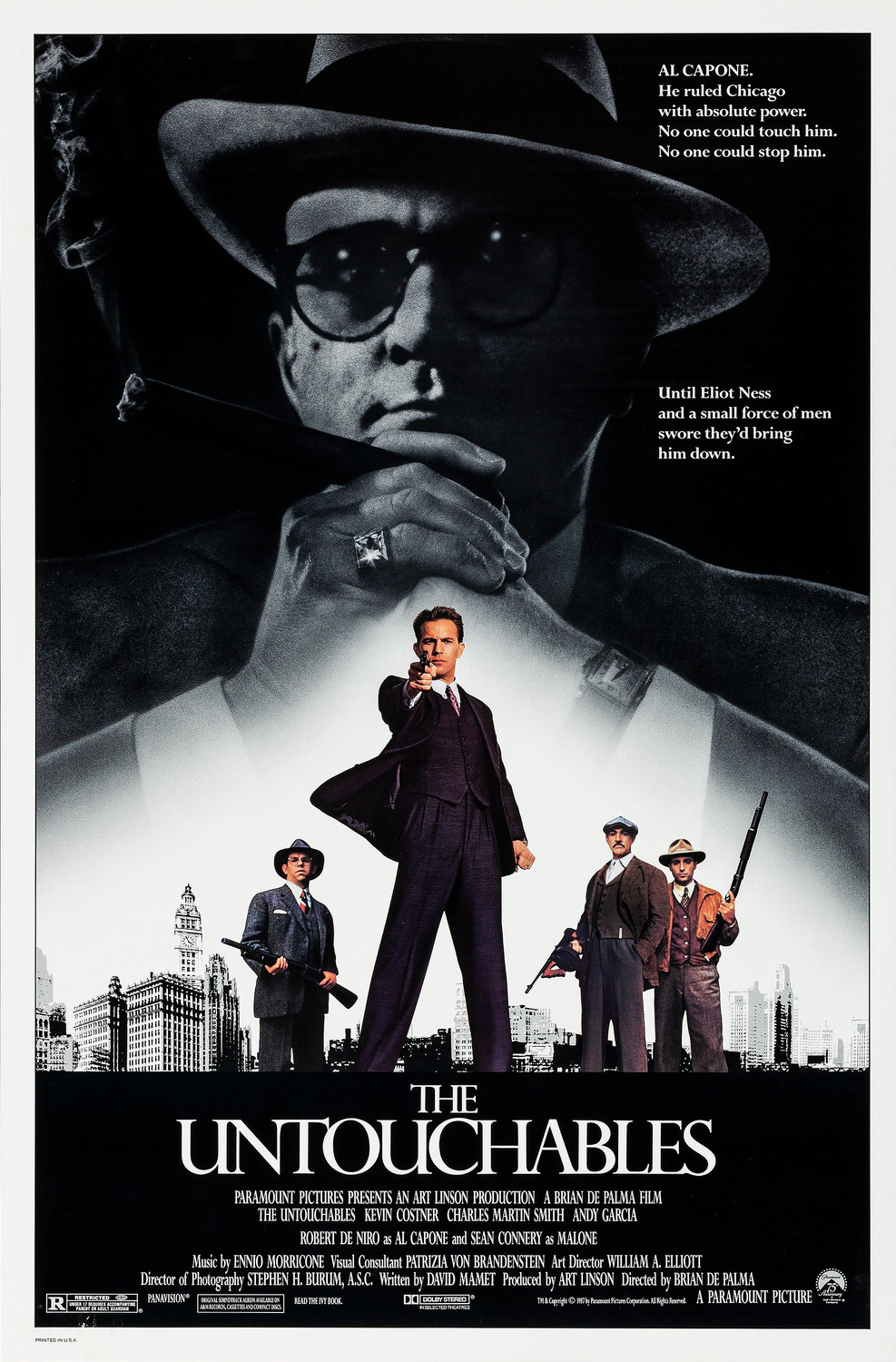
“The Untouchables”
1987
R
Produced by: Art Linson
Directed by: Brian De Palma
Written by: David Mamet
Starring: Kevin Costner, Sean Connery, Charles Martin Smith
Paramount Pictures
4.21/5 Stars
Consensus: A film
that feels as classical as the era it addresses, The Untouchables is
both memorable and well worth watching.
Plot: The story of
the cops who brought down Al Capone (Robert DeNiro) during the prohibition era
of the United States .
Directing: De
Palma is most successful at creating an extremely classical tone in his more
modern film; with various nods to famous films such as Battleship Potemkin
(1925) De Palma has a breath of the classic era of Hollywood that feels refreshing from an 80’s
flick. De Palma seemed to struggle, however, with his actor’s character arch,
they seem under-directed, and notably less developed than they otherwise could
have been. As a cast the actor’s never seem to quite develop a chemistry or
unity together and instead feel, well… like scripted actors, and it’s
unfortunate from such an otherwise polished and well toned film that this
happens, but its there in more than a few parts where you realize, “oh hey…
these guys are just acting, in a good movie with a good plot, but they don’t
believe this.” The chemistry and tone of the actors lies largely with the
director and this film struggled to find that peak, although the script,
atmosphere, and all other aspects of the film were spot on. ***1/2
Acting: Again, a
lack of direction hurt this otherwise great production, and we see in this film
some polarity within the acting stratosphere. In particular Robert DeNiro (Al
Capone) is spot on in his performance and delivers one of the most outstanding,
and memorable, gangsters in film history. On the other hand we have Kevin
Costner (Eliot Ness) who seems to struggle to get into his “tough-guy” cop and
instead seems weak and un-emotional, maybe even a bit detached from everything
that is going on. Whatever it is he’s doing, it doesn’t fit with what his
character seems to be saying, or going through at all. Costner’s weak performance only makes
DeNiro more desirable, and his (DeNiro's) serious lack of screen time more noticed and
missed. Overall, the acting is extremely polarized and has its
incredibly strong moments along with its outrageously weak and un-buyable ones. ***
Editing: In this
area the film managed to really shine. The editing in the film was gorgeous and
well done. Most particularly the “Odessa
steps” sequence wherein Costner is in the midst of a shoot-out while trying to
help a woman with a stroller up the stairs at a train station. This direct nod
to Battleship Potemkin was beautifully edited together and created both intensity
and beauty within the same sequence. The overall pacing of the shots and their
placement was well done throughout the film, and this area may this films
strongest point. *****
Art Direction: The
re-creation of 1920s-40s prohibition era America contained one of the most
classic tones in any film. The re-creation of suits, skirts, cars and streets
was wonderfully rendered and was yet another area this film shined in. Again,
the film felt classical, like it had been made during the golden age of Hollywood , the exact
time-era the film was attempting to address. An enormous part of this tone is
the art direction, and the art direction here was spot on. *****
Cinematography: The
film opens majestically with some extreme wide shots of 1920s America and the
gorgeous cinematography continues from there on out. Another wonderful shot
looking directly down at Al Capone as he is getting a shave suggests that,
Capone, the only person looking up at the camera, is totally set apart from
everyone else in the room. He is the brains of the operation, and perhaps the
only person looking opportunity dead-on. This and many other wonderful shots
constitute some of the best cinematography in film history. *****
Screenplay: While
the screenplay was good, and told an excellent story, it needed to be more
rapid-fire to capture the tone the rest of the film so magnificently rendered. While
the screen play wasn’t a complete failure, it lacked much of the intensity and
wit that other gangster films such as Goodfellas (1990) or even a
classic film noir such as Sunset Blvd. (1950) or The Maltese Falcon
(1941) delivered so prominently. This was disappointing and inconsistent with
the rest of the film’s tone and pacing, but not entirely damning as the
screenplay certainly had its brilliant moments, most of the them with DeNiro,
but overall the screenplay was just good. ***
CGI/Special Effects: These
are especially well done and still look great even by today’s standards. Most
of the special effects are explosions, and we’re ok with that since they look
great and feel cool. Other blood and gore effects look grizzly and harsh, as
they should, and overall the special effects were tactfully used and realistic
looking. *****

No comments:
Post a Comment