Friday, October 25, 2013


Bad Religion
“Bad Religion EP”
1981
Epitaph

3.33/5 Stars
Consensus: Although it sounds like it was recorded in a toilet, and could easily be mistaken for just about any hardcore punk band from the 80s “Bad Religion EP” represents some of the most primal and raw sounds from the group in their early years. While it’s hardly the greatest album of all time, or even Bad Religion’s career, it’s certainly a commendable start and an interesting listen.

1) Bad Religion – The opener on the album sounds great and instantly grabs you in. It has every raw and biting aspect one would expect from a punk rock album in 1981. There are enough tempo changes to grab attention and a catchy chorus to boot makes for a great song. ****
2) Politics – Not giving anyone a moment’s breathe the EP transitions into another biting fast paced song. “Politics” is punk rock standard by all means, it’s raw and gritty and it sounds like its been recorded in a toilet, which adds to the element and gives it a more raw and gritty edge. ****
3) Sensory Overload – The album reaches a lower point here and this song is particularly hard to get into at first, but does eventually manage to be catchy and redemptive. The intro sounds sloppy and out of place with the rest of the song and the song never seems to find its sweet spot, save for a couple brief moments.  **1/2
4) Slaves- Heading back to the formula of the first two tracks “Slaves” offers more “standard” hardcore punk, and it sounds great. It’s aggressive, frustrated and falls apart at the end. It fits perfectly on the album while staying fresh. ***1/2
5) Drastic Actions – The intro is the concave to “Sensory Overload” and is super grabbing and catching. The song then gets quite adding a nice dynamic to the otherwise only loud CD. Unfortunately there are a couple of nasty vocal peaks that come from low quality recordings, this kills a lot of the song and makes it hard to listen to as the levels are constantly changing. This song is also the longest on the album (a whooping 2:36) and has the least interesting aspects and tempo changes to offer, making it suffer further. **

6) World War III – This wonderful 0:55 second song is straight-forward and to the point and ends on a perfect note, just as the album was about to get redundant, Bad Religion pulls out, having said their piece. The aggressive vocals and fast guitar make this the perfect ending song to a great EP. ****

Monday, October 21, 2013


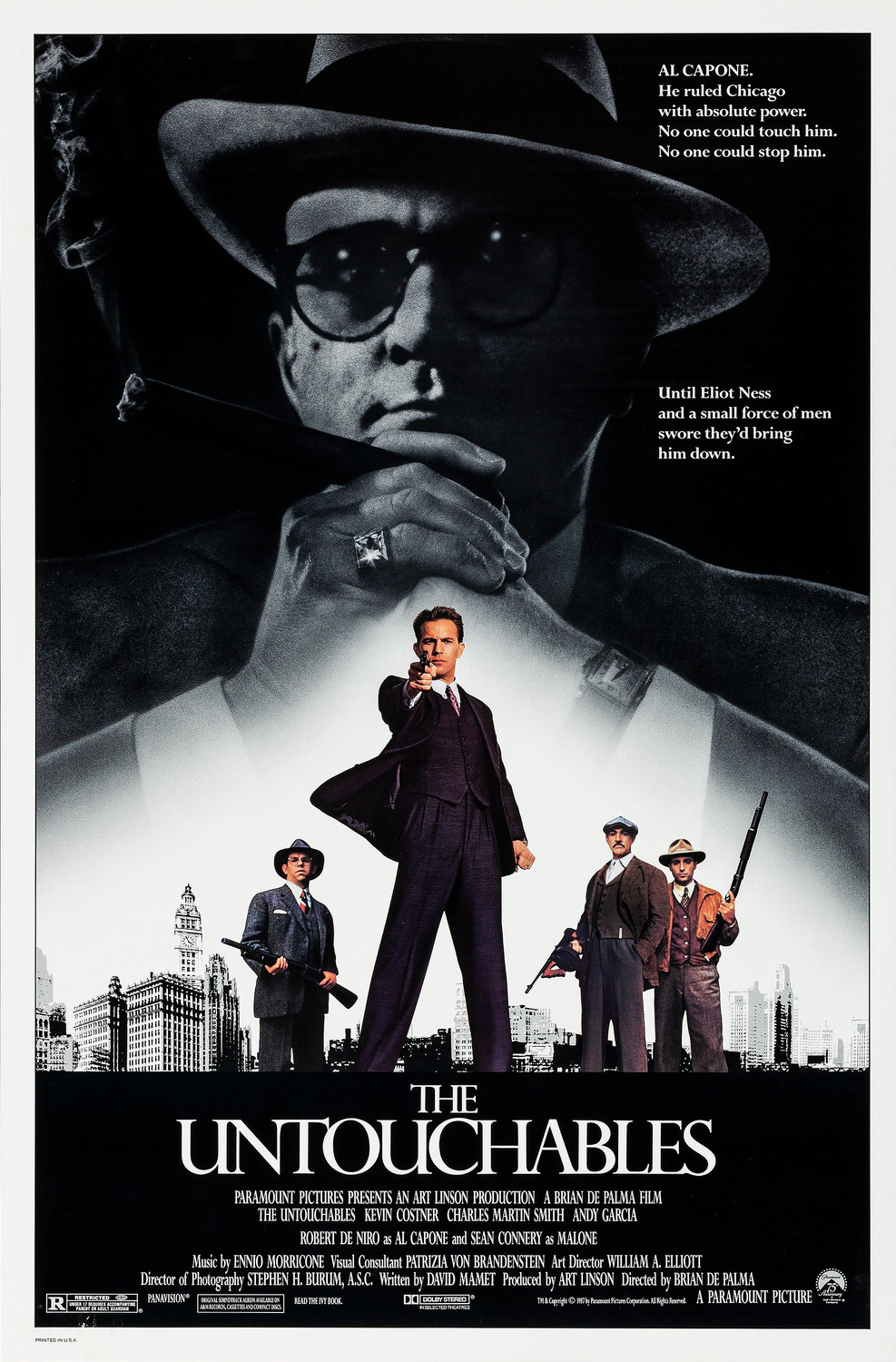
“The Untouchables”
1987
R
Produced by: Art Linson
Directed by: Brian De Palma
Written by: David Mamet
Starring: Kevin Costner, Sean Connery, Charles Martin Smith
Paramount Pictures

4.21/5 Stars
Consensus: A film that feels as classical as the era it addresses, The Untouchables is both memorable and well worth watching.

Plot: The story of the cops who brought down Al Capone (Robert DeNiro) during the prohibition era of the United States.

Directing: De Palma is most successful at creating an extremely classical tone in his more modern film; with various nods to famous films such as Battleship Potemkin (1925) De Palma has a breath of the classic era of Hollywood that feels refreshing from an 80’s flick. De Palma seemed to struggle, however, with his actor’s character arch, they seem under-directed, and notably less developed than they otherwise could have been. As a cast the actor’s never seem to quite develop a chemistry or unity together and instead feel, well… like scripted actors, and it’s unfortunate from such an otherwise polished and well toned film that this happens, but its there in more than a few parts where you realize, “oh hey… these guys are just acting, in a good movie with a good plot, but they don’t believe this.” The chemistry and tone of the actors lies largely with the director and this film struggled to find that peak, although the script, atmosphere, and all other aspects of the film were spot on. ***1/2

Acting: Again, a lack of direction hurt this otherwise great production, and we see in this film some polarity within the acting stratosphere. In particular Robert DeNiro (Al Capone) is spot on in his performance and delivers one of the most outstanding, and memorable, gangsters in film history. On the other hand we have Kevin Costner (Eliot Ness) who seems to struggle to get into his “tough-guy” cop and instead seems weak and un-emotional, maybe even a bit detached from everything that is going on. Whatever it is he’s doing, it doesn’t fit with what his character seems to be saying, or going through at all. Costner’s weak performance only makes DeNiro more desirable, and his (DeNiro's) serious lack of screen time more noticed and missed. Overall, the acting is extremely polarized and has its incredibly strong moments along with its outrageously weak and un-buyable ones. ***

Editing: In this area the film managed to really shine. The editing in the film was gorgeous and well done. Most particularly the “Odessa steps” sequence wherein Costner is in the midst of a shoot-out while trying to help a woman with a stroller up the stairs at a train station. This direct nod to Battleship Potemkin was beautifully edited together and created both intensity and beauty within the same sequence. The overall pacing of the shots and their placement was well done throughout the film, and this area may this films strongest point. *****

Art Direction: The re-creation of 1920s-40s prohibition era America contained one of the most classic tones in any film. The re-creation of suits, skirts, cars and streets was wonderfully rendered and was yet another area this film shined in. Again, the film felt classical, like it had been made during the golden age of Hollywood, the exact time-era the film was attempting to address. An enormous part of this tone is the art direction, and the art direction here was spot on. *****

Cinematography: The film opens majestically with some extreme wide shots of 1920s America and the gorgeous cinematography continues from there on out. Another wonderful shot looking directly down at Al Capone as he is getting a shave suggests that, Capone, the only person looking up at the camera, is totally set apart from everyone else in the room. He is the brains of the operation, and perhaps the only person looking opportunity dead-on. This and many other wonderful shots constitute some of the best cinematography in film history. *****

Screenplay: While the screenplay was good, and told an excellent story, it needed to be more rapid-fire to capture the tone the rest of the film so magnificently rendered. While the screen play wasn’t a complete failure, it lacked much of the intensity and wit that other gangster films such as Goodfellas (1990) or even a classic film noir such as Sunset Blvd. (1950) or The Maltese Falcon (1941) delivered so prominently. This was disappointing and inconsistent with the rest of the film’s tone and pacing, but not entirely damning as the screenplay certainly had its brilliant moments, most of the them with DeNiro, but overall the screenplay was just good. ***


CGI/Special Effects: These are especially well done and still look great even by today’s standards. Most of the special effects are explosions, and we’re ok with that since they look great and feel cool. Other blood and gore effects look grizzly and harsh, as they should, and overall the special effects were tactfully used and realistic looking. *****

Friday, October 18, 2013

“Reservoir Dogs”
1992
R
Produced by: Lawrence Bender
Directed by: Quentin Tarantino
Written by: Quentin Tarantino
Starring: Harvey Keitel, Tim Roth, Michael Madsen
Live Entertainment

4.79/5 Stars
Consensus: A Tarantino classic that is one of the most memorable, witty, and iconic gangster films ever made. 

Plot: A group of robbers are assembled to hold up a jewelry store, as complications with the robbery arise a rat is suspected among them.

Directing: Quentin Tarantino is as vicious and witty early on as he became later in his career. The dialogue is sharp, the characters aggressive and quick-tongued, and the whole film flows from violent mishap to violent mishap in a way only Tarantino can deliver. It feels a bit “film school-ish” at times, but manages to do so with the nostalgia and charisma one expects from a Tarantino film. While this clearly is not the sweet spot he would one day hit in Pulp Fiction (1994), the directing is still distinctly his, and is very holding. ****1/2

Acting: The actors all appear to be enjoying the hell out of what they are doing. Harvey Keitel (Mr. White) is great at being a gruff, but loyal gangster, his epiphany of betrayal at the end is so wonderfully communicated to the camera that it creates one of the most memorable scenes in film history. Chris Penn (Nice Guy Eddie Cabot) also gives a priceless performance along with all the other actors in the film who are memorable, and distinct. *****

Editing: Not enough good can be said of Tarantino’s fast and wild editing. The sheer pacing of the film, and the order in which it was assembled screams brilliance, let alone the flawless and gorgeous transactions that are numerable in every scene. What stands out the most is our opening exposition, the team of robbers assembled before the robbery at a diner, to the immediate cut towards the near end of the event, a man screaming and bleeding in the back of a get-away car. The sound editing is further brilliant as we hear intermittent “sounds of the 70’s” radio incorporated throughout the film as a back drop. That Tarantino had the imagination to assemble the film as such, and that he further does it with such taste and tact is impressive to say the least. One of the most superbly edited films ever made. *****

Art Direction: Especially considering the films low budget ($1,200,000) Tarantino manages to keep Los Angeles feeling as authentic as ever in this crime caper. The art direction is classy and feels very real, it succeeds especially well at re-creating the 70’s pleather and disco feel its radio intervals seemed to infer. The art direction was further successful by nodding to 70’s b-crime films while creating its own distinct flair at the same time. The art direction is perfect for what this film is, it feels like an over-the-top b-film from the 70’s, with a lot more class and certainly more style. *****

Cinematography: The film is again successful in this category. One of the most memorable, and pretty, shots in the entire film is when Mr. Blonde (Michael Madsen) leaves a warehouse to go and get something from his car, and is trailed by the camera, as he get to his car the camera stops, waits for him to get the item and then resumes following him again as he heads back into the ware house. Overall the cinematography is also exceptionally well done. *****

Screenplay: Classic Tarantino, who can be considered one of the greatest screen writers of all time, is again ever on his a-game in this film as he is in his later films. The witty banter and creative, albeit, vulgar dialogue, is as much, or if anything is more, an important of the film than any action sequences or turn of events. The fact that the majority of the film takes place in one, maybe two rooms, with a couple additional locations, and that Tarantino manages to entertain us with characters who are mostly just talking about things that have recently happened to them, makes a strong argument that this is one of the better screenplays ever written. It’s short, sweet, brutal, and to the point. *****


CGI/Special Effects: The most “special effects” that went into this film is an excessive amount of blood. It is gorgeous flowing blood, but nothing that stands out so much as to say that the film relied heavily on this category if at all. One fake looking bullet in Quentin Tarantino’s head as Mr. Brown, argues that the film likely had the low budget it did, and that perhaps works for it as much as against it in maintaining its specific “b-esq” tone. **** 

Monday, October 14, 2013


Nausicaa Of The Valley Of The Wind
1984
PG
Produced by: Rick Dempsey, Isao Takahata
Directed by: Hayao Miyazaki
Written by: Hayao Miyazaki
Starring: Alison Lohman, Mark Silverman, Tress MacNeille (English translation)
Hakuhodo

4.92/5 Stars
Consensus: Hayao Miyazaki is a cinematic genius and has on his résumé some of the most impressive films ever made. His early work is no exception to this brilliance, and Nausicaa is a fine gem in this anime sovereign’s crown.

Plot: After a devastating war that ravaged the planet a survivor named Nausicaa (Alison Lohman) seeks to understand the poisonous jungle, and the horrific insects that dwell there, that have sprung up as natural rebuttal for humanities crimes.

Directing: Not enough can be said about the sheer genius of Hayao Miyazaki. His eye for detail and vivid story telling is astounding, and shows even in his early works such as this film. He manages to create a world that immediately engulfs the viewer and doesn’t let them leave until he has said what he needs to. The pacing of the film is spot on, as is the vivid attention paid to detail and plot. Only a genius like Miyazaki could take us to such outlandish places and make them come alive in such depth. *****

Acting: When a Miyazaki film is translated into English it is always given the finest cast of English voice actors, and rightfully so as the talent needs to match the exceptional quality exhibited in story telling and animation. This film is no exception to that rule and the exceptionally talented voice cast manages to be intriguing and delightful. Patrick Stewart (Lord Yupa) is especially keen at lending us his magnificent talent and endearing voice. Overall the cast was delightful and spot on in pitch and voice acting. *****

Editing: Once again, Miyazaki is a genius and his choice of exposition and the order therein, match perfectly with the story being told; Nausicaa flows brilliantly between several subplots, all of which are incredibly constructed, and then manages to incorporate other key flashbacks. The editing in the film ads depth, insight, and important texture to the already astounding genius it is. The film’s strength lies in its excellent structure, all of which is rooted in its editing. *****

Art Direction: While it is early Miyazaki, and doesn’t quite match up to the richness of his later films, the animation and detail is still vivid and gorgeous, it’s different but that isn’t necessarily a bad thing. One of Miyazaki’s strengths is his ability to create an exceptionally detailed image that still focuses attention on what he wants you to see. In other words; the animation is vivid and big, but still manages to tell a story rather than simply show off the animators’ ability, something a film like Star Wars Episode 1: The Phantom Menace (1999) struggled with. While it looks different, and perhaps less developed than later Miyazaki, this is still a gorgeously animated film and deserves as much praise as his later work. *****

Cinematography: Animated films differ greatly from normal expectations within this category. The rule of thirds and perspective shown were all done gorgeously (see above), and while a camera did capture these images, it isn’t quite the same, so there isn’t a whole bunch to contribute to this category. n/a

Screenplay: The screenplay is a fluent and wonderful story with rich characters and incredible sub-plots. That said, this is an English translation of a Japanese film, and in this case there are a couple moments of… iffy or awkward translation, or so it felt. While this is hardly notable and barely detracts, if at all, from the otherwise brilliance of the characters, plot, and world created here, it still exists and must be taken into consideration. Again, it’s not noticeable, and hardly something to get your knickers in a twist about, but there are more than a few awkward lines, that likely result from poor translation, rather than a poor original script. ****1/2


CGI/Special Effects: Miyazaki’s animation is a standard maker; he continually raises the bar of what should be expected from animated films, especially Japanese anime. After watching a Miyazaki film, other animated films seemingly lose there sparkle because they just simply are not as good. There is so much to say about the brilliance of his animation, and his auteur as an in general, but it is better to be seen then read, and to attempt to describe in any great length would be far too wordy for our purposes here. Behold Miyazaki, king of the animated film. *****

Friday, October 11, 2013


The Hunts
“We Were Young”
2013
MCM

2.95/5 Stars
Consensus: While it has its moments, the album is just alright and very forgettable. The Hunts will get better as they get older and this is a commendable freshman album.

Sounds like: Mumford & Sons + Paul Simon + Death Cab for Cutie

1) Make This Leap – The album starts decently enough. “Make This Leap” is a bit redundant, and takes some time to find its sweet spot. The incorporation of a mandolin makes the song stick out a little more, and the violins in the song are tactfully placed, a nice tempo change towards the end followed by almost a'cappella gang vocals save the song from total mediocrity. ***
2) Lifting the Sea – This song feels the most Paul Simon-esq on the album, and certainly has the most organic feel to it. It is again refreshing to hear so many non-traditional instruments used in this song. However the song lacks a lot of charisma lyrically, and feels very sappy at times. The further the song goes on the less real it feels, and the more annoying it gets. With more depth and soul, this song would be significantly better, but what it ultimately adds up to is a pre-teen Raffi. **1/2
3) Above the Storm – The intro to this song is far too long, and again redundant. The Hunts do however exhibit one of their major strengths, that being 7 capable vocalists within their band. There is no question that a lot of talent is displayed here, but that doesn’t save this song from sounding very corporate and soulless. If it had been generated by a music making computer and performed by the very sincere and bright eyed Hunts, it would come as no surprise. Overall it is very drawn out and uninteresting. **
4) Worn – This ballad is irrepressibly dull and forgettable. With a tempo to match a funeral and the most predictable build up of all time, it takes every ounce of control to not skip this song after 30 seconds. That said, it does sound mostly different than the previous three songs on the album, an impressive feat, but ultimately no savior of the otherwise dull and forgettable 5:36 this song ends up being. **
5) This Is Love – Easily the strongest song on the album, this song is catchy and easy to get into. The transition between singers is flawless, and the lyrics are meaningful. The music behind the lyrics is powerful, unique and tactful. Perhaps the strongest thing this band has going for them is their willingness to incorporate non-guitar-bass-drums-singer instruments into their music. This song has especially effective use of this. With only a few seconds of less appealing bridge time this otherwise wonderful song is epic and memorable and stands out the most on the album. ****1/2
6) Green Eyes – The intro to this song is the most confusing and put-offish aspect to it. It is an audio clip of some sort, apparently of a man boarding a train or something inaudible, but it seems to have little significance that is easily distinguishable. Although the lyrics to this song are cute, it lacks a lot of the power it could have. It either needs to be much quieter, and played solo, or it needs to have impressive and extreme dynamics. It lacks both, but is still a decent song nonetheless. ***
7) Next to Me – The lyrics of this song flow extremely well and the use of ukulele with minimalist background instruments is effective. This song is also extremely catchy and memorable and is the second best on the album. Again the most impressive element of this song is the flow of the lyrics and the soulful singing in the song. It still has its “Raffi” edge to it, but that isn’t per-say a bad thing. ****
8) Be Naïve – Pretty vocal harmonies and nice piano create a very appealing lullaby. This is what the album’s early “Worn” and “Above the Storm” wanted to be. The three songs sound most similar, but this is the best executed of the three (whereas the other two are dull and forgettable). However, like the majority of the album, “Be Naïve” lacks the soul and voice character it needs to be a great song. This is frustrating as its potential is so apparent, and so squandered. ***
9) Beloved – Banjo, as a rule in folk and anywhere else it may be used, is one of the prettiest instruments to listen to. Putting it on the album this late makes you only think how lamentable it is that the banjo had not been more present and forefront on the rest of the album. This song has an especially appealing spiritual aspect to it that, again should have been present on the previous 8 tracks, but was absent. The overall tone of the song is very specific and makes for a strong song with a lot of power behind it. ****

10) Morning Light – Again with the lengthy Coldplay-esq piano intros, that are just thoroughly dull, and at this point in the album, predictable and boring. The ending of the album is one of its weakest points, and is the equivalent of the long speech from a relative while you are trying to leave their house and go back home. It holds no attention and doesn’t stand out at all. As soon as it begins, it should end. *1/2

Friday, October 4, 2013


Mr. Bean’s Holiday
2007
PG
Produced by: Eric Fellner, Tim Bevan, Peter Bennett-Jones
Directed by: Steve Bendelack
Starring: Rowan Atkinson, Steve Pemberton, Lily Atkinson
Universal Pictures

3.14/5 Stars
Consensus: Fun, but forgettable, Mr. Bean’s Holiday is great for an hour, but then gets a tad redundant.

Plot: Ever addled, but well-meaning, Mr. Bean wins a dream vacation to Cannes and manages to separate a young boy from his father.  

Directing: Nothing out of the norm comes from this film. The directing is well enough, but not exceptional. With a character as classic as Mr. Bean, Bendelack does manage to do his material justice and keeps the spirit of the original series alive in the film. That said, not all of the sequences totally made sense, especially towards the end, but frankly Bean is a one-gag show, and to carry that gag on for two hours is asking a lot from anyone. Although the film did get redundant towards the end, it managed to stay fresh longer than expected.  **1/2

Acting: Rowan Atkinson (Mr. Bean) is as phenomenal as ever in his now familiar role. His pantomime, that mimics silent era legends such as Charlie Chaplin or Buster Keaton, is spot on and he displays more than a little talent for his physical humor. It’s fairly redundant to note that everyone else is a back drop to his antics, but the supporting cast seems to have a blast doing what they are doing. William Dafoe (Carson Clay) especially manages to pull off a delightful parody of a self-absorbed Hollywood director, and seems to have had a ball doing so. All of the supporting cast resonated a similar feeling. It’s hardly “Best Actor” material, but its fun and tactfully executed. ***1/2

Editing: The editing matches the pacing of the skits well, even adding to some of the original scenarios. One example is of Bean’s classic skit in a high end restaurant wherein the food served is less-than-appetizing, and he must get rid of it. This sequence particularly benefited from including close-ups of the hideous sea-food and cut away shots inside the purse Bean was stowing it. Overall the editing matched the pacing of the skits well and managed to add to familiar scenes, making them funnier, or at least more vivid. ****

Art Direction: The art direction, much like the directing of the film, had nothing stand out, everything seemed fairly normal and everyone was dressed to meet their various parts. Bean is in his classic tan suit, and all the characters he interacts with have been given an update from the late 80s/early 90s wherein Bean was spawned. One bit that stood out however was a sequence wherein Bean manages to find some old Third Reich uniform on a film set and is marching up and down, pretending to play soldier. In this case the costuming and set design etc. fit perfectly for the role. Overall the art direction was well done, but not exceptionally done, very much like the directing of the film. **1/2

Cinematography: Again, nothing particularly stands out in this category; in fact the only cinematography that was very interesting at all was in the mock film Dafoe’s character makes and screens. Everything else was very cut and dry, it was clear the producers wanted to “play it safe” with this film, and for good reason, when one’s target audience is families with small children one does not put monumental effort into elaborate shots. A couple tactful close-ups here and there however assure that there was a degree of skill put into the film. The cinematography is very cut-and-dry and has almost nothing notable about it. **1/2

Screenplay: The screenplay was the film’s greatest weak point. As funny as Mr. Bean may be for 20-30 minutes on BBC on a Sunday afternoon, 2 hours of Bean following a single plot line is asking a bit much. Especially for a character that doesn’t speak. Many of the character motives made little sense, and some of the situational comedy within the film was a bit too far-fetched, especially after 2-hours. Needless to say, the characters are stock characters and are one dimensional and physical gags can only go so far without becoming redundant. A clear plot and motive never seem to really emerge from this shoty-at-best screenplay. **


CGI/Special Effects: Of all the praise this film deserves, perhaps it should be most noted that it is very free of many special effects you now see saturated in contemporary film. Atkinson, as per usual, does all his own stunts and scenes, for which we’re grateful. There is one explosion, and it looks great and authentic, and outside of that we manage to see good ol’ fashioned pantomime performed by one of the comic geniuses of our time. *****